An intro to economic cycles

This article is the second part of a series of three. If you missed the first one, here’s the link: A look into the future
There is established economic theory and research that indicates the hypothetical future we described in the previous article is not only possible, but probable, cyclical and consistent.
Back in the 1920’s, economist Nikolai Kondratiev described repeating cycles. These are generally referred to as Kondratiev cycles or technological cycles, primarily driven by technological change and inequity. As existing technologies reach limits, inequity is created by high barriers to competition, and new innovations enable new sources of value, creating revolutions that change the basis for how things work, and opportunities to bypass traditional competitive barriers.
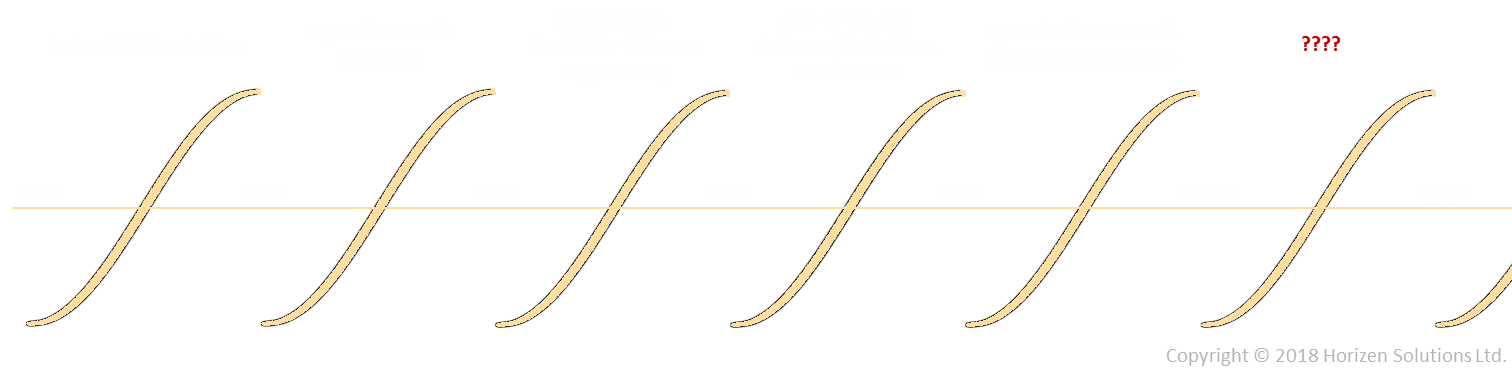
We are well into the maturity stage of the current age, and innovation has been stagnating since mid-2000’s, despite increased R&D spending. Either it’s getting harder or we are getting worse at innovation, or perhaps a combination of both… A major change is imminent
Looking at the past, it’s not hard to correlate rough dates where cycles change, with aspects of the future we described, or with the history of past cycles: Think of the post-war depression the UK suffered from 1919-1926, the growth enabled by mass production leading to the golden age of the 50’s and 60s followed by the recession of the 70’s initially arising from the energy crises, but compounded by inequality and social unrest leading to strike action and the infamous ‘three-day week’. This was then followed by the 80’s where computers and mobile phones were the poster children of renewed economic confidence and expansion. It’s now pretty apparent that these technological cycles have a pretty clear impact on, and overlap with traditional economic cycles.

So if the past repeats, what comes next?
A transition period, uncertainty & confusion, rapid and fundamental change, fluid priorities, new opportunities, and a major risk of economic depression.
Business will continue as it always has, and we will adapt, won’t we?
Think of the defining businesses of these cycle periods and how they enter on the capabilities that define the cycle and then typically struggle in the next. Consider the railway mania consolidation of the 1840s, giving way to the dominance of business like Carnegie Steel, displaced by the incoming ‘corporation states’ that were General Motors and Ford, which have in turn been pushed aside by the ascendance of silicon valley’s big 5: Amazon, Apple, Facebook, Google, Microsoft, whose positions currently seem unassailable.
The next article will conclude this series of three by exploring what innovation as a competence looks like and how you can build it, to prepare for and thrive during the challenges ahead…
Edit: If you want to learn more about technological cycles, we suggest this book by Carlota Perez